How to Mark Up an Orchestral Part
The pencil marks experienced players use, drawn as they look in a real part: spectacles, cues, bowings, cuts and the rest, with what each means and when to write it. A free card.
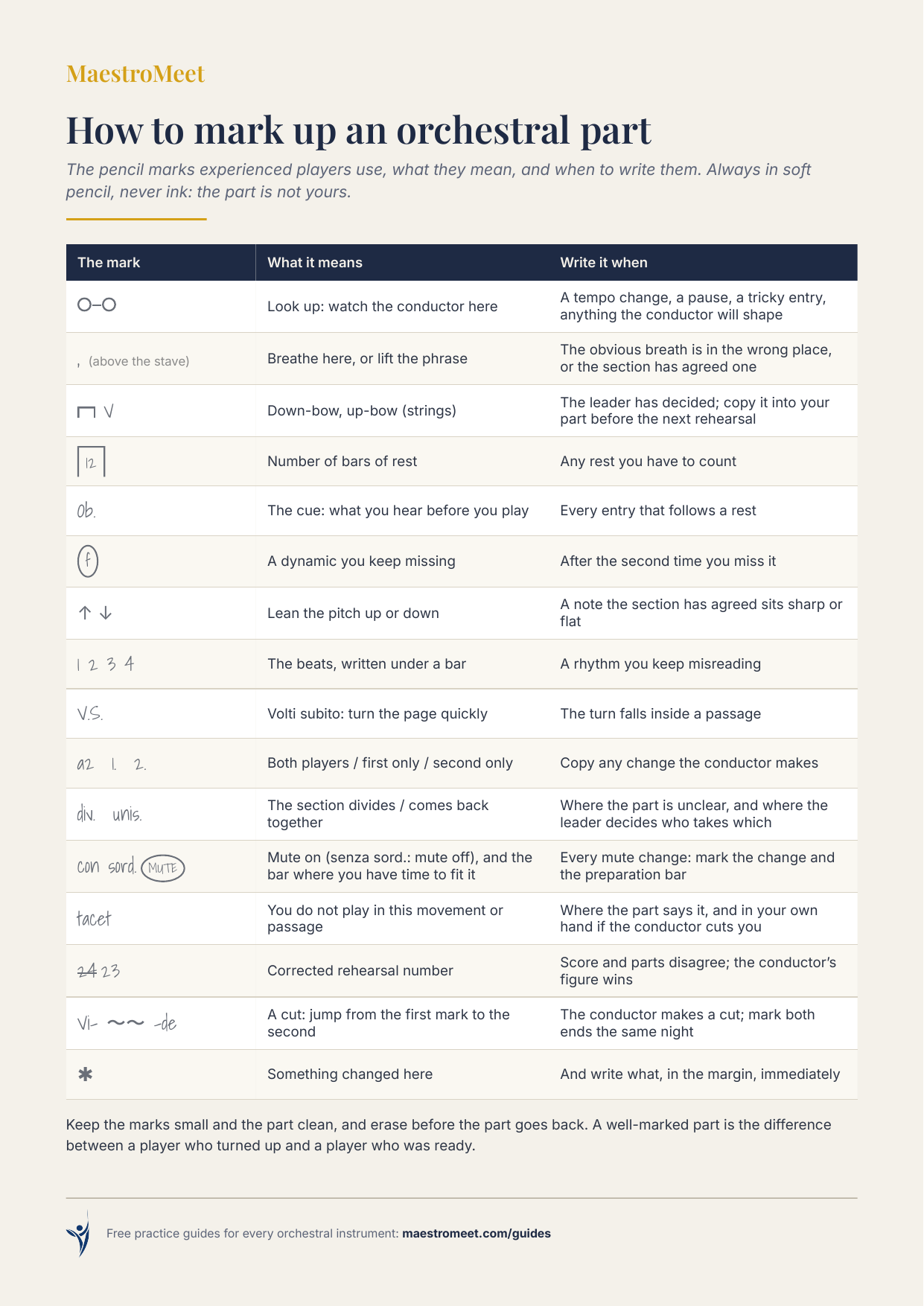
Print it and it lives in the front of your folder; save it to your phone and it is there at the rehearsal break. It is free, and there is nothing to sign up for.
Download the PDFWhat is on the card
Sixteen marks in one table: the spectacles that mean watch the conductor here, the breath comma, down-bow and up-bow, the bracketed rest count, the cue instrument, circled dynamics, pitch arrows, beat numbers under a bar, V.S. at a bad page turn, a2 and the divisi pair, mute changes marked with a preparation bar, tacet, corrected rehearsal figures, the Vi-de cut, and the asterisk that means something changed here. Soft pencil always, and erase before the part goes back.
Related
This card pairs with the free practice guide for your instrument — all twelve are on the Guides hub — and with the other reference cards on the Cards hub.
A marked part is a plan; playing it with the orchestra around you is the rehearsal. On MaestroMeet you play your part with the score scrolling in front of you and the rest of the orchestra around you, so what this card teaches has something real to land on. MaestroMeet is opening soon — join the waitlist to be among the first to play.
Join the waitlistRaise your instrument and play.
Know a player whose part is bare?
Please pass this card on. It is free, there is nothing to sign up for, and every musician it reaches is one more reason to keep the music flowing.