How to Practise the Orchestral French Horn at Home
The most useful way to practise an orchestral French horn part at home — the instrument usually called simply the horn in an orchestra — is to play it with the rest of the orchestra around you, not alone. The horn sits in the middle of the texture, binding wind and brass together, and its famously exposed entries are judged entirely by how they sit against the chord around them — a note that is gloriously in tune on its own can still be wrong in the harmony. Practised alone, the line gives you none of that, which is exactly what makes the horn so unforgiving to prepare in silence.
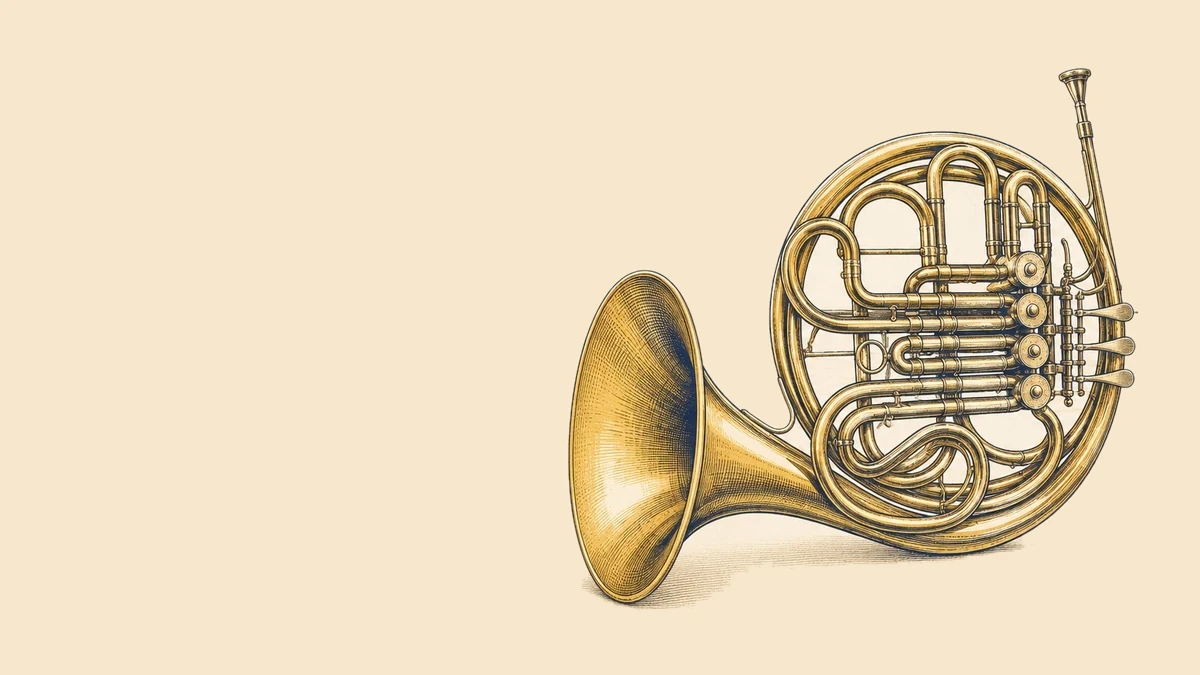
The right hand is a second tuning slide
The cupped right hand in the bell is not a rest for the instrument; it is one of your most precise tools for tuning and accuracy. Easing it a little further in or out shifts the pitch — most usefully, it draws the high notes, which tend to run sharp, down into tune — and, just as importantly, it steadies the upper register so notes speak where you aim them instead of splitting. A great deal of what players put down to lip or nerve in the high range is really a question of hand position. Cup the palm gently, let the hand take the shape of the bell, and resist gripping; the gain in security can be startling.
Accuracy is a hearing problem before it is a lip problem
High on the horn, the natural notes of the harmonic series crowd close together, so the wrong one answers at the slightest miscalculation — which is the real source of the instrument’s fearsome reputation for split notes. The remedy is not force; it is hearing the exact note in your head an instant before you play it. Buzz entries on the mouthpiece alone, sing them, and work against a drone so the pitch is fixed in your ear before the horn is even involved. A note you can hear clearly is a note you will usually land.
Know your two horns
On the double horn, learn when to take a note on the F side and when on the B-flat — broadly, the F side is warmer and steadier low down, the B-flat side cleaner and more secure higher up — and gather the alternate fingerings that suit your instrument. The only test that matters is the result: if a fingering speaks cleanly and in tune, it is the right one for that passage.
One horn, in F
The horn is a transposing instrument with an unusually tangled history: orchestral parts were written for the horn crooked in a whole range of keys — in E, in E-flat, in D, in high and low B-flat and more — with composers choosing the crook that suited the music, and the player expected to transpose each one at sight. On MaestroMeet every horn part is provided for the horn in F, the transposition in which modern parts are written and which almost all players now read; where the original was written for another crook, the part is given to you in F. You therefore read one consistent transposition across the whole library and can put your attention into the playing rather than the arithmetic. Reading fluently in the older keys remains a valuable skill — in a professional orchestra you will still meet them — but standardising on F keeps the library consistent and the page in front of you familiar.
Stopped horn
The horn owns a special colour, the stopped note, made by sealing the hand in the bell to give a compressed, brassy sound. Stopping raises the pitch: with F-horn fingerings a stopped note sounds a semitone sharp, so you finger a semitone lower than written (on the B-flat side the shift is nearer three-quarters of a tone, which is why most players stop on the F side or use a stopping valve). When a passage is stopped, play it open first so you know exactly what the pitches should be, then stop it, with the corrected fingerings, and give it full air — the effect wants energy. Resist the urge to jam the hand deeper to find it, which only pushes the pitch sharper still; a firm, angled seal does the work.
Mutes, which are not the same thing as stopping
Two instructions on a horn part look similar and mean quite different things, and the pitch consequence is different too. Con sordino asks for a mute, a cone placed in the bell, and on the horn as on the other brass that usually means a straight mute. A plus sign above the note, or the words stopped, gestopft or bouché, asks for the hand sealed in the bell instead. The semitone rule described above belongs to stopping. It does not apply to a mute.
What a mute does to the pitch is its own question. Most straight mutes push the instrument sharp, and as a rule the tighter the mute the more it pushes, because a mute of that shape shortens the air column the instrument is working with. The bucket mute is the usual exception and tends the other way. Some modern straight mutes are built with more internal volume so that they hold the pitch, so the one in your bag may behave better than the general rule suggests. The only way to know is to check yours against a drone rather than trust a description.
A mute can also stop particular low notes speaking, and this is worth knowing because it looks like a fault in your playing when it is not. Players report specific notes in the low register that will not centre, or will not sound at all, with a mute in, and which notes those are depends on the mute rather than on you. The cause is a resonance belonging to the cavity inside the mute interfering with the instrument's own, which is why the usual remedy is a different mute, or a vented one: venting moves the problem to another pitch rather than removing it. Find out which notes misbehave on your own mute and plan around them instead of pushing harder.
The rest is preparation. Mark every change in the part, and where the time looks short, buy it at both ends by putting the mute in earlier than the marking and taking it out later, using whatever rest exists either side. Keep the mute where your hand already is rather than on the floor by your chair. Seat it firmly, with a small twist, so it cannot work loose during the phrase. And do it silently: an audience will forgive a slightly late entry, and will certainly notice a mute hitting the floor.
A word on auditions
Horn excerpts test accuracy under pressure, control in the high register, evenness across the two sides of the horn, and the nerve to play exposed entries cleanly. A panel hears every split and every note that sits outside the harmony. Practising an excerpt as it sits in the piece, against the chord it belongs to, rather than as a bare line, is the closest preparation at home to the moment itself.
Related guides
More from the brass family: trumpet, trombone and tuba. Or return to the Guides hub.
This is the kind of practice MaestroMeet was built for. You play your part with the score scrolling in front of you and the rest of the orchestra around you, so your entries, your tuning and your timing have something real to fit into. On the Premium plan you can choose which parts appear on the scrolling score — calling up the lines around you to see exactly how yours fits — and you can quiet your own line, the minus-one, so you step into the part yourself with the orchestra still playing. MaestroMeet is opening soon — join the waitlist to be among the first to play.
Join the waitlistRaise your instrument and play.
Know a horn player who would find this useful?
Please pass it on. The guide is free, there is nothing to sign up for, and every musician it reaches is one more reason to keep the music flowing.