How to Practise the Orchestral Trombone at Home
The most useful way to practise an orchestral trombone part at home is to play it with the rest of the orchestra around you, not alone. The trombone has no keys and — the F-attachment aside — no valves: the slide alone sets the pitch, which makes it the one brass instrument that can place a note anywhere the slide will reach, and the one whose intonation rests most completely on your ear. Played against the orchestra, that ear has something to lock onto; played alone, it has only itself.
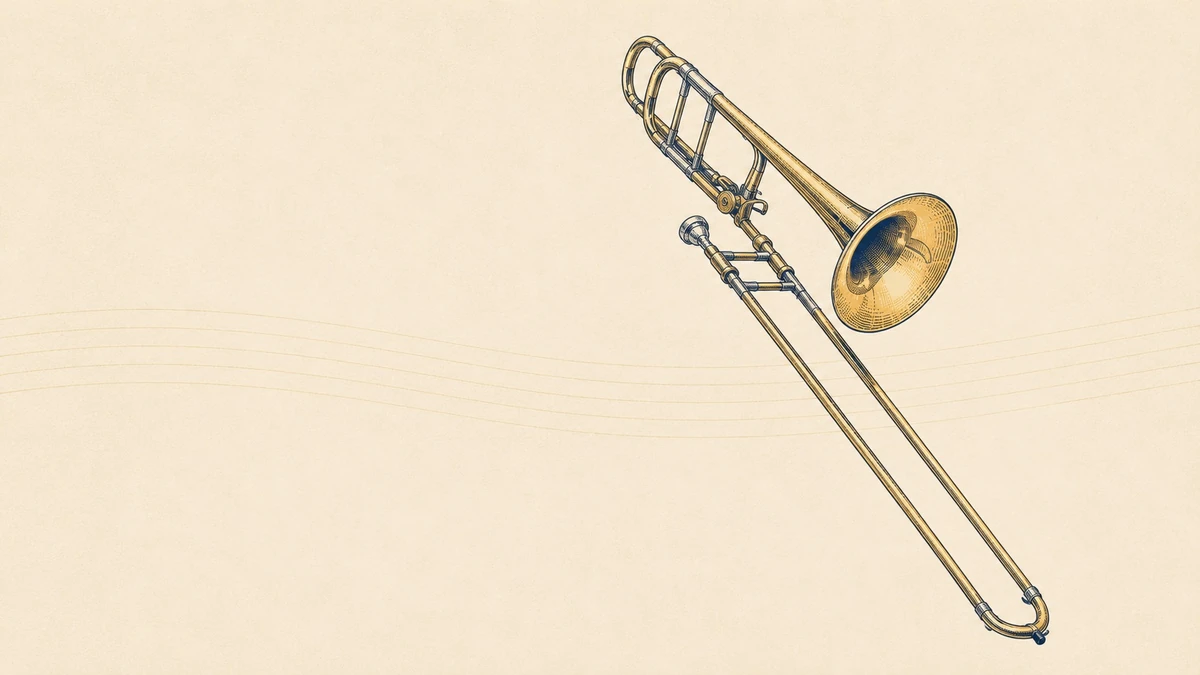
There are no fixed positions — only your ear
The seven slide positions taught to beginners are a starting map, not the truth. The exact spot for a note shifts across the range, because each note sits on a different overtone and each overtone has its own pitch tendency, so the same ‘position’ is a touch longer here and shorter there. The professional does not reach for a measured place; they hear the note clearly first and let the arm find the pitch. Practise slowly against a drone, listening for the beats to disappear, and build a set of inner landmarks — how one note feels in the arm, how another resonates — rather than trusting the slide to be in the ‘right’ spot.
How to slur on a slide
Because the slide must travel between notes, a plain slur risks a glissando smearing the two together. The trombonist’s answer is a feather-light ‘lah’ of the tongue that marks each new note while the slide moves as fast as it possibly can between them — just enough to interrupt the air, not enough to sound like an articulation. Where the change of note is also a change of overtone and the slide moves against the pitch — out while the pitch rises, in while it falls — or where the slide need not move at all, a true natural slur is available instead, because no glissando can form. Clean legato is one of the things that most separates a polished trombonist from a merely capable one, and it repays slow, deliberate work.
Choose your positions, and your alternates
Many notes can be played in more than one position, on different overtones, and choosing well is a real craft. A well-chosen alternate avoids a scramble from one end of the slide to the other, smooths a legato, steadies a tricky attack, and sometimes makes an awkward passage possible at all. The catch is that the intonation of an alternate differs from instrument to instrument, so experiment on your own instrument, slowly and with a tuner, and keep the ones that speak cleanly and in tune. A famous low, exposed solo or an ungainly run is often transformed by a single better position.
If you play the bass trombone
The bass trombone is not simply a larger tenor. Its wider bore, bigger mouthpiece and valve attachments open up the bottom of the orchestra and bridge the gap down towards the pedal register; the valves give you secure low notes and alternate positions the hand-slide alone cannot reach. As the foundation of the trombone section, your clarity and pitch down low anchor the whole brass sound, so give the low register its own study — clear articulation and steady air keep it defined rather than letting it slide into a rumble.
Read all three clefs
Orchestral trombone parts are written in bass clef most of the time, rise into the tenor clef whenever the writing sits high, and in a good deal of principal repertoire are written in the alto clef. All three turn up, and a player who reads only bass clef will one day open a part and find the page has changed language on them.
The two C clefs are the same symbol in different places, which is the whole difficulty and also the whole solution. In tenor clef, middle C sits on the fourth line up; in alto clef, on the middle line. Learn where middle C lives in each and the rest follows.
There is a good reason they exist. Bass clef pushes high writing into a thicket of ledger lines; move the same passage into tenor or alto and it drops back onto the staff, where the eye reads shape instead of counting lines. Practise each until you are not translating but simply seeing notes. This matters more on the trombone than on almost anything else, because your left hand is not solving the pitch for you: the arm has to find it, guided by the ear, and any attention spent working out what the note is has been taken from the job of playing it in tune.
The long wait, and the entry at the end of it
The trombone section is not used continuously. You will sit through whole movements and then arrive exposed, often loud, on an instrument that has been doing nothing while everyone else has been warming up. That shape is the job, and it cannot be practised by playing your part straight through.
Keep the instrument warm, and it is worth knowing why, because the usual explanation is wrong. The metal expanding and contracting has almost nothing to do with it. What matters is the temperature of the air inside the tube: sound travels faster through warm air than cold, so the same length of instrument resonates higher when the air in it is warm. That is why blowing through works and standing the instrument near a heater does much less, and why the problem returns after every long silence rather than once at the start of the evening.
Count from something real. A long rest is not counted by counting; it is counted by knowing what happens inside it, which instrument has the material, and what the bar before you sounds like. A number in your head is fragile; a sound you are waiting for is not. And prepare the entry rather than the passage: the note that goes wrong is rarely the difficult one later in the phrase, it is the first one, and it goes wrong in the silence beforehand.
Mutes change the pitch, not only the colour
Most straight mutes push the instrument sharp, and as a rule the tighter the mute the more it pushes, because a mute of that shape shortens the air column the instrument is working with. The bucket mute is the usual exception and tends the other way. Some modern straight mutes are built with more internal volume so that they hold the pitch, so the one in your bag may behave better than the general rule suggests, and the only way to know is to check yours against a drone rather than trust a description.
A mute can also stop particular low notes speaking, and this is worth knowing because it looks like a fault in your playing when it is not. Players report specific notes in the low register that will not centre, or will not sound at all, with a mute in, and which notes those are depends on the mute rather than on you. The cause is a resonance belonging to the cavity inside the mute interfering with the instrument's own, which is why the usual remedy is a different mute, or a vented one: venting moves the problem to another pitch rather than removing it. Find out which notes misbehave on your own mute and plan around them instead of pushing harder.
The trombone has an advantage here that the valved brass do not: the slide can absorb the correction as you play, note by note, where a valved instrument must pre-set a tuning slide. But absorbing it is a decision, not an accident, so make it before the rehearsal and not during the entry.
Mark every change in the part. Where the time looks short, buy it at both ends by putting the mute in earlier than the marking and taking it out later, using whatever rest exists either side; most changes that look impossible are only impossible if you begin them on the beat they are written. Keep the mute where your hand already is, in the crook of a knee, in the lap, or on a stand that clips to the music stand. Seat it firmly, with a small twist, so it cannot work loose. If it still will not go, give up a note rather than the change, the last one before or the first after, and tell your colleagues which so that somebody covers it. Whatever you do, do it silently.
A word on auditions
Trombone excerpts test slide-led intonation, clean legato across positions, a noble sound in exposed solos, and rhythmic precision in the loud tutti passages the section is known for. A panel hears every smeared slur and every position a touch out. Practising an excerpt as it sits in the piece, against the parts around it, rather than as a bare line, is the closest preparation at home to the room.
Related guides
More from the brass family: horn, trumpet and tuba. Or return to the Guides hub.
This is the kind of practice MaestroMeet was built for. You play your part with the score scrolling in front of you and the rest of the orchestra around you, so your entries, your tuning and your timing have something real to fit into. On the Premium plan you can choose which parts appear on the scrolling score — calling up the lines around you to see exactly how yours fits — and you can quiet your own line, the minus-one, so you step into the part yourself with the orchestra still playing. MaestroMeet is opening soon — join the waitlist to be among the first to play.
Join the waitlistRaise your instrument and play.
Know a trombonist who would find this useful?
Please pass it on. The guide is free, there is nothing to sign up for, and every musician it reaches is one more reason to keep the music flowing.