How to Practise the Orchestral Tuba at Home
The most useful way to practise an orchestral tuba part at home is to play it with the rest of the orchestra around you, not alone. The tuba is the floor the whole orchestra stands on — most chords are tuned downward to it, and the bass line you play sets the pitch and the time for everyone above. Practised alone, none of that weight is there; with the orchestra around you, you can hear what it means to be the foundation rather than just the lowest part.
Breathe more than you think, and breathe low
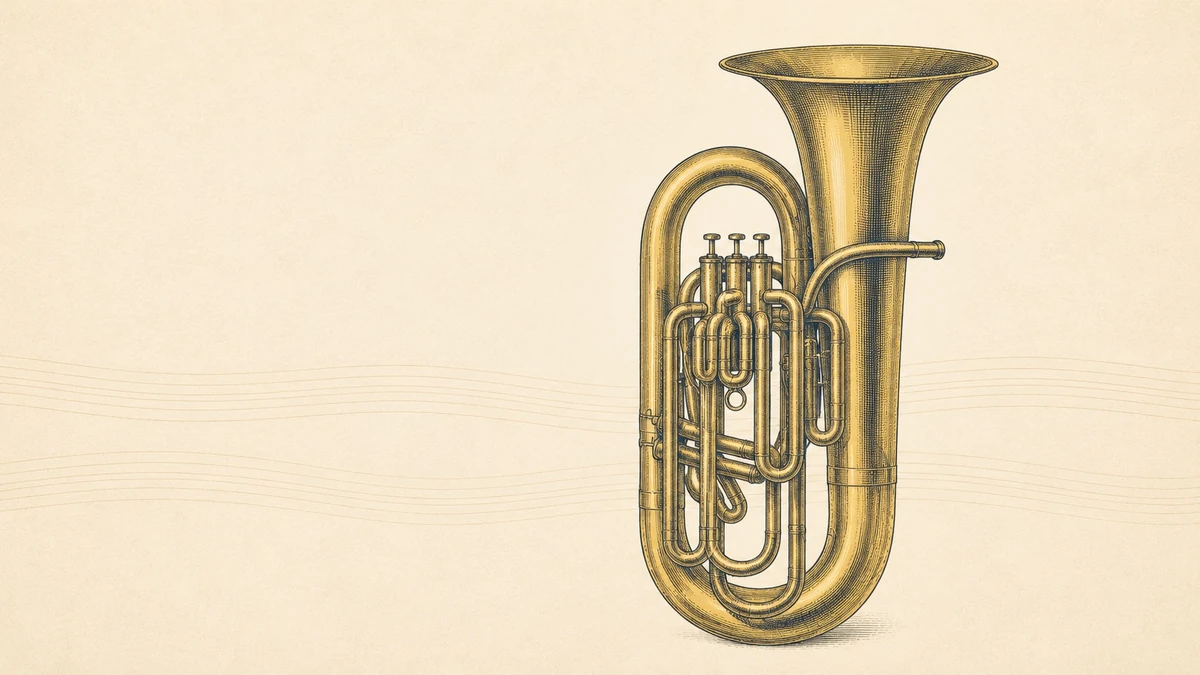
The tuba carries anything from about twelve to eighteen feet of tubing, depending on its key, and it asks for as much air as any instrument in the orchestra. The breath must be large and, above all, low: let the belly and the back fill first, keep the throat open — the feeling of a quiet, cool ‘O’ — and never lift the shoulders, which tightens the throat and strangles the sound. A great deal of tuba playing is really breath management, and time spent on big, low, relaxed breathing pays back across the whole range.
Play ahead of the beat
Such a large instrument speaks slowly: there is a genuine delay between your air arriving and the note sounding. As the foundation of the orchestra, though, your note has to land exactly on the beat — so you learn to commit the air a fraction early, placing the start of the note slightly ahead so the sound arrives on time. This anticipation is one of the things that separates an orchestral tubist from a capable player, and that can only be felt against other musicians, which is what practising with the orchestra around you provides.
Keep the bottom clear
The low register is where the tuba earns its place, and also where the sound most easily turns to mud. Clarity comes from a relaxed, open embouchure — no pinching, no smiling — from fast, plentiful air, and from clean articulation that defines the front of each note. Develop the pedal register patiently; it strengthens your tone, intonation and control everywhere else. A clear, centred low note is not only better for you, it is a service to the whole ensemble tuning down to it.
Centre the pitch with your ear
Several notes live on each tuba fingering, drawn from the harmonic series, so the fingering is only half the answer — your ear and lips place the note. Buzzing on the mouthpiece alone, and matching pitches to a keyboard or a drone, trains you to centre each note before you play it, which steadies both intonation and response. Since the orchestra rests its tuning on you, that centred pitch matters more for the tuba than for almost any other instrument.
How your part is written, and why it depends where you learned
Two traditions exist here, and knowing which one you are in saves a great deal of confusion.
In orchestral and wind-band writing as it is normally published, a tuba part is written in the bass clef at concert pitch. It is not transposed for the instrument you happen to own. The page says which notes should sound and it is your business to produce them on whatever tuba is in your hands, so a player on a B flat instrument and a player on a C instrument read the same notes and press different valves. In that tradition the fingerings belong to the instrument rather than to the page, which is why moving between tubas is real relearning and not a change of case.
In British-style brass bands, and in some national teaching traditions, the parts are transposed instead, and often written in the treble clef. There the fingerings stay the same from one instrument to another and the part changes rather than the hands, and players brought up that way are taught to transpose at sight when a transposed part is not supplied.
Neither is more correct than the other, but they produce players with different reflexes. If you were taught one and are handed the other, the page will feel wrong for reasons that have nothing to do with your playing, so find out which convention a part uses before you decide that something is your fault.
Which tuba, and why players own more than one
There is no single orchestral tuba. The instruments are built at different pitches, and which one a player reaches for depends on the repertoire, on the sound wanted, and to a real degree on where in the world they trained.
Broadly, the larger instruments, in C and in B flat, carry the weight of the big orchestral repertoire, while the smaller ones, in F and in E flat, are lighter and more agile, speak more easily higher up, and suit exposed and solo writing. Many professional players own one of each kind and choose by the music in front of them. National habit matters too, and it is habit rather than law: the C tuba is the usual orchestral choice in America and much of Europe, while the B flat is the backbone of the British brass band tradition.
If you own one instrument, this is not a problem to solve. It is context, so that you know why the player next to you at a course has a different-looking tuba, and why a passage that fights you might not fight them.
You are usually the only one
There is one tuba in most orchestral scoring. That is easy to say and it takes a while to feel. It means there is no section to blend into, nobody a semitone away to check yourself against, and no second player to carry the line while you take a mute out or find the breath. Where a violinist can be a little out and be absorbed, you cannot: everything above you is tuning downward to what you play, so a note that is cloudy or late is not a small local problem, it is the floor moving.
The practical consequence is that the things you would otherwise do between notes have to be planned. Where the breath goes, where a mute goes in, and where you can afford to be a fraction less than perfect. None of it can be improvised, because there is nobody to improvise behind.
A word on auditions
Tuba excerpts test breath and stamina across long phrases, clarity and pitch in the low register, rhythmic steadiness as the section’s anchor, and a surprising amount of soft, controlled playing. A panel hears every note that arrives late or sits cloudy at the bottom. Practising an excerpt as it sits in the piece, against the players who depend on it, rather than as a bare line, is the closest preparation at home to the real thing.
Related guides
More from the brass family: horn, trumpet and trombone. Or return to the Guides hub.
This is the kind of practice MaestroMeet was built for. You play your part with the score scrolling in front of you and the rest of the orchestra around you, so your entries, your tuning and your timing have something real to fit into. On the Premium plan you can choose which parts appear on the scrolling score — calling up the lines around you to see exactly how yours fits — and you can quiet your own line, the minus-one, so you step into the part yourself with the orchestra still playing. MaestroMeet is opening soon — join the waitlist to be among the first to play.
Join the waitlistRaise your instrument and play.
Know a tuba player who would find this useful?
Please pass it on. The guide is free, there is nothing to sign up for, and every musician it reaches is one more reason to keep the music flowing.