How to Practise the Orchestral Double Bass at Home
The most useful way to practise an orchestral double bass part at home is to play it with the rest of the orchestra around you, not alone. The double bass is the foundation the whole orchestra stands on — it sets the harmony from the bottom and, with the cellos, the time as well, and everyone above tunes and places their notes in relation to it. Practised alone, none of that responsibility is audible; with the orchestra around you, you can hear what it means to be the floor rather than just the lowest line.
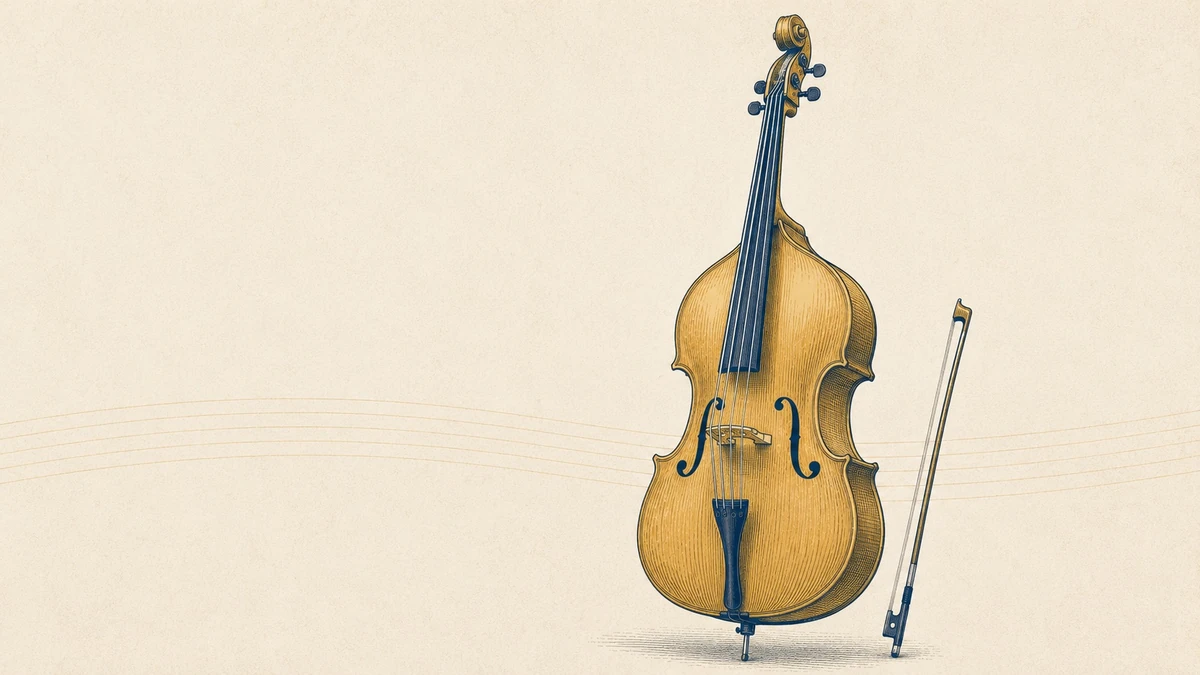
Hear the note before you play it
The bass has the longest strings of any bowed instrument, so a semitone covers a large distance and you are shifting almost constantly — no other string instrument moves the hand so far so often. On such a long string there is no time to play a note and then correct it; you must hear the pitch clearly in your head and place the hand where you already know it lives. Practise slowly, pre-hearing each note, use the natural harmonics along the string to check your places, and free up your shifting so the arm moves economically rather than lunging. Intonation on the bass is decided before the note sounds, not after.
The notes are given; the bowings are yours
One thing to be clear about, because it is part of orchestral preparation rather than a detail. The scrolling score gives you the notes and the composer’s own markings — the slurs, the staccato and accents, the dynamics, and the pizzicato and arco instructions are all there, because they are part of the music. What it does not give you — most raw orchestral parts do not — are the bow directions — which way the bow travels, up or down — and the left-hand fingerings. Those are yours to decide, until the section decides them for you. Work them out in advance, mark them in, and then keep them fixed; when the leader’s bowings arrive at rehearsal, copy them in at once, because a section in which every player has settled the same bowing is a section that moves as one, and a passage whose fingering you have settled is a passage you can rely on under pressure.
Play ahead of the beat
Like the largest brass, the bass speaks slowly: the thick strings take a moment to answer, especially down low. As the foundation of the orchestra, though, your note has to arrive exactly on the beat, so you learn to commit a fraction early, placing the start of the note slightly ahead so the sound lands on time and the orchestra has a floor to stand on. This anticipation can only be felt against other players, which is what practising with the orchestra around you provides.
Give pizzicato its own practice
Orchestral writing asks the bass to pluck far more often than the other strings, and orchestral pizzicato is its own craft, quite different from a jazz line: the aim is a clean, full, ringing note with a dry attack and no fingerboard buzz, drawn from the fleshy pad of the finger rather than snatched. Practise it as deliberately as you practise the bow — evenness, a warm tone, and enough length that the note speaks and rings rather than clicking and dying — because in the orchestra it carries the bass line as surely as the bow does.
A word on auditions
Double bass excerpts test steadiness of pulse as the orchestra’s anchor, clarity and pitch in the low register, secure shifting across the long string, and clean orchestral pizzicato. A panel listens for the player the whole section can rely on for time and tuning. Practising an excerpt as it sits in the piece, against the players who depend on it, rather than as a bare line, is the closest preparation at home to the real thing.
Related guides
More from the string family: violin, viola and cello. Or return to the Guides hub.
This is the kind of practice MaestroMeet was built for. You play your part with the score scrolling in front of you and the rest of the orchestra around you, so your entries, your tuning and your timing have something real to fit into. On the Premium plan you can choose which parts appear on the scrolling score — calling up the lines around you to see exactly how yours fits — and you can quiet your own line, the minus-one, so you step into the part yourself with the orchestra still playing. MaestroMeet is opening soon — join the waitlist to be among the first to play.
Join the waitlistTake up your bow and play.
Know a double bassist who would find this useful?
Please pass it on. The guide is free, there is nothing to sign up for, and every musician it reaches is one more reason to keep the music flowing.